Boston, MA – August 25-27, 2022
[Well this is long overdue… I started this post the week after attending the conference and then just let is sit (oops). Made a few tweaks and am sharing it now, hope you enjoy!]
This past week I attended my first Society of American Archivists (SAA) conference, in Boston, MA, and had a fantastic time! I was greatly encouraged by the themes of many of the presentations, including Courtney Chartier’s SAA Presidential Address, Katrina Spencer and Jamillah Gabriel’s Keynote Address on Spencer’s “The Comprehensive Guide to Resisting Overcommitment,” and “Community-Driven Archives Initiative: BIPOC and Queer Solidarity and Collective Power” by Torrez, Soto, Salow, and Menchaca.
As a new professional in the field, and first time conference attendee, it was heartening to hear established archivists recognize and discuss important challenges to policies and practices which have long perpetuated abuse and harm to archivists, subjects of records, their communities, and researchers.
In addition to the presentations, I also had the chance to meet up with virtual friends (who unknowingly also graduated from Queens College!), present my Graduate Student Poster, enjoy delicious meals, and of course, visit a cemetery. SAA 2022 was a much-needed professional development retreat, as well as a long-overdue reprieve from the New York City summer.
Graduate Student Poster
Poster Planning
I mentioned in my first post (Cemetery Visit) that I was finalizing my physical poster for the conference, having just submitted my digital version for virtual attendees. Now that the conference is over, I am excited to share the posters and process with everyone!
I submitted my graduate student poster proposal in March 2022 and received an email saying it had been approved on May 12; an incredibly exciting and (personally) nerve-racking experience as I completed my MLS capstone. The resulting poster, “Cemeteries as Community Archives: Unconventional Records, Ethics of Care, and Equitable Access” was a coalescence of my research for my MLS/MA capstones.
My history paper examined the legal regulation of New York City cemeteries in the late eighteenth and early nineteenth centuries; arguing that their prohibition and removal from lower Manhattan was a result of political, economical, and territorial expansionist efforts, and not simply a matter of public health. My archives-focused MLS paper assessed the need for a cemetery metadata schema, where I designed and modeled its elements, a visual/descriptive dictionary of terms, and physical and digital mockups of information ingest forms and XML displays. The inspiration for “Cemeteries as Community Archives” can be found at the intersection of the grander themes behind these papers.
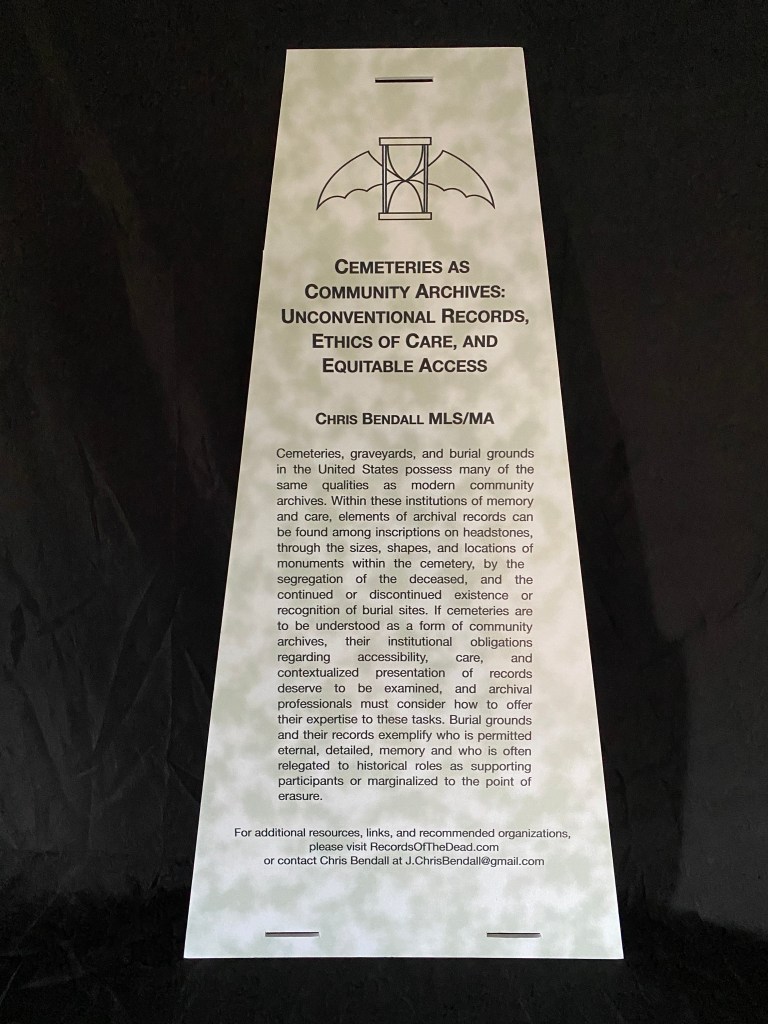
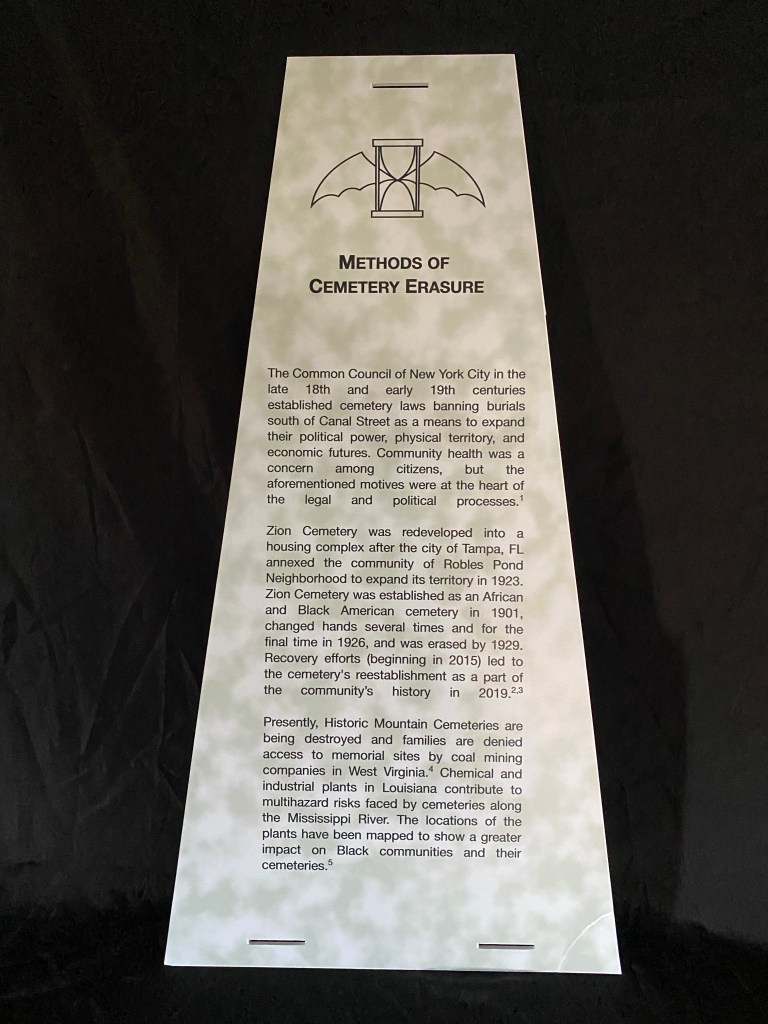
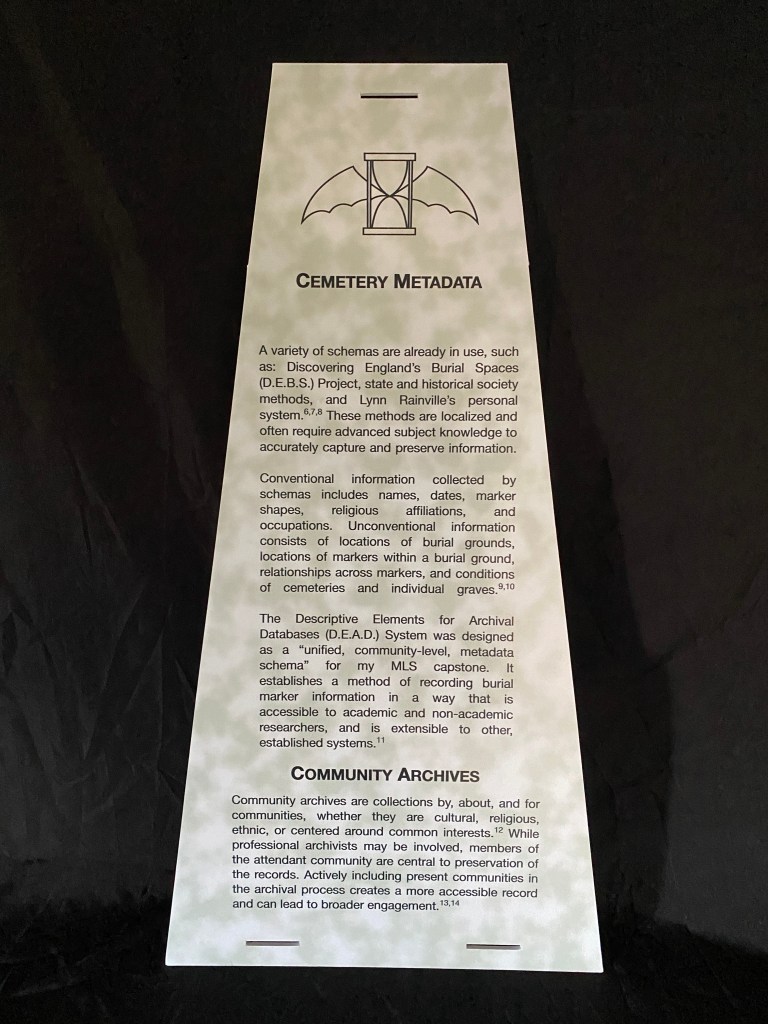

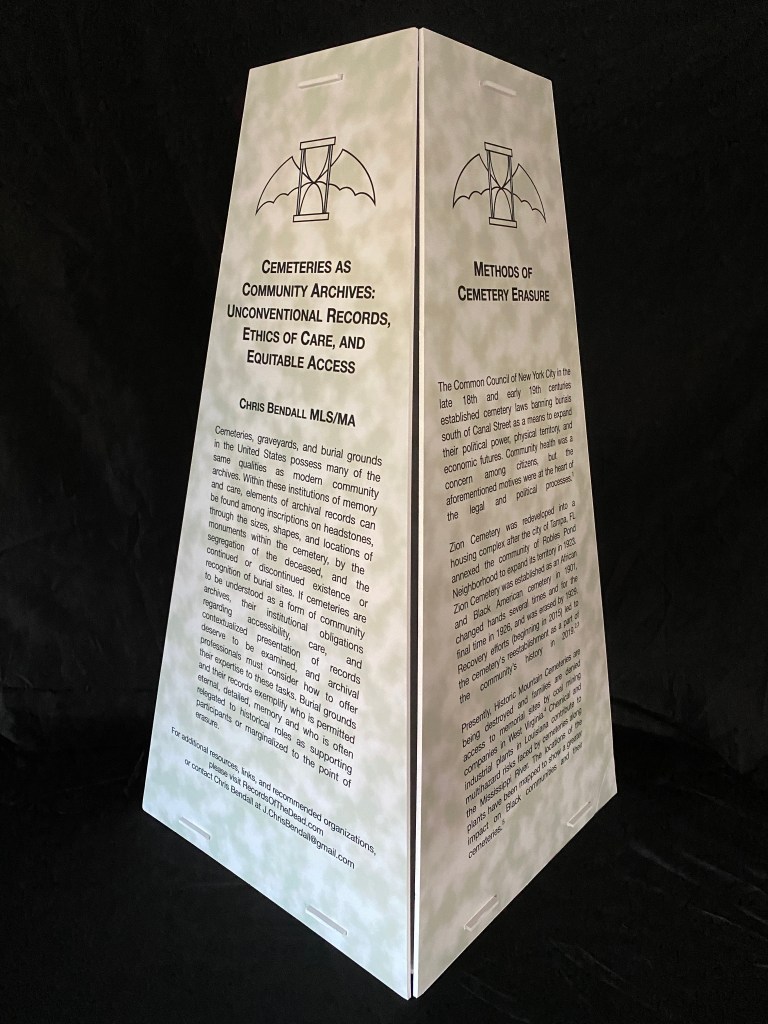
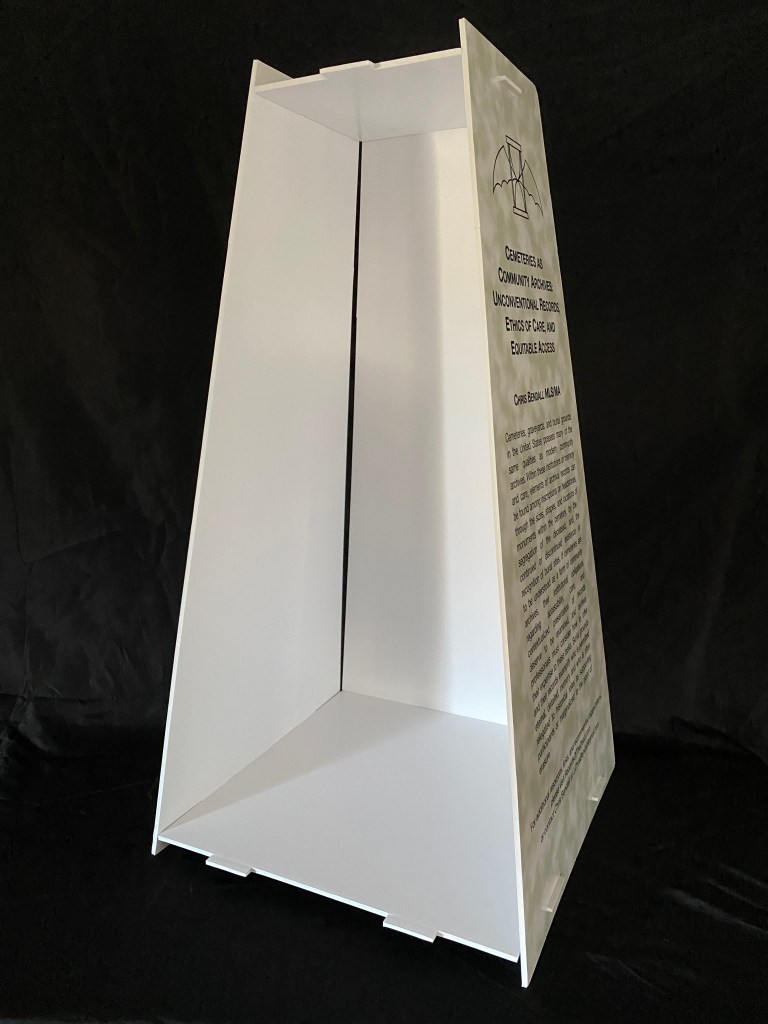
When I received the email confirming my poster proposal had been accepted I wasn’t quite sure it was real! I had all the usual fears one has when submitting a passion project to a new venue. I did not think my studies would be “real-world” applicable so soon, and am honestly still (after an incredible conference) trying to figure out how to make them more broadly accessible.
The design of my digital poster was fairly straightforward and my final submission looked very much like my initial idea. With many thanks to Felicia Owens (SAA’s Governance Program Manager) my unconventional physical poster idea also came to fruition! I was able to construct a three-dimensional, four-sided, obelisk-shaped poster out of foam board, featuring the same content as my digital submission. I also built a turntable for the poster to rest on so spectators had the ability to see all four sides.
The Conference Presentation Experience
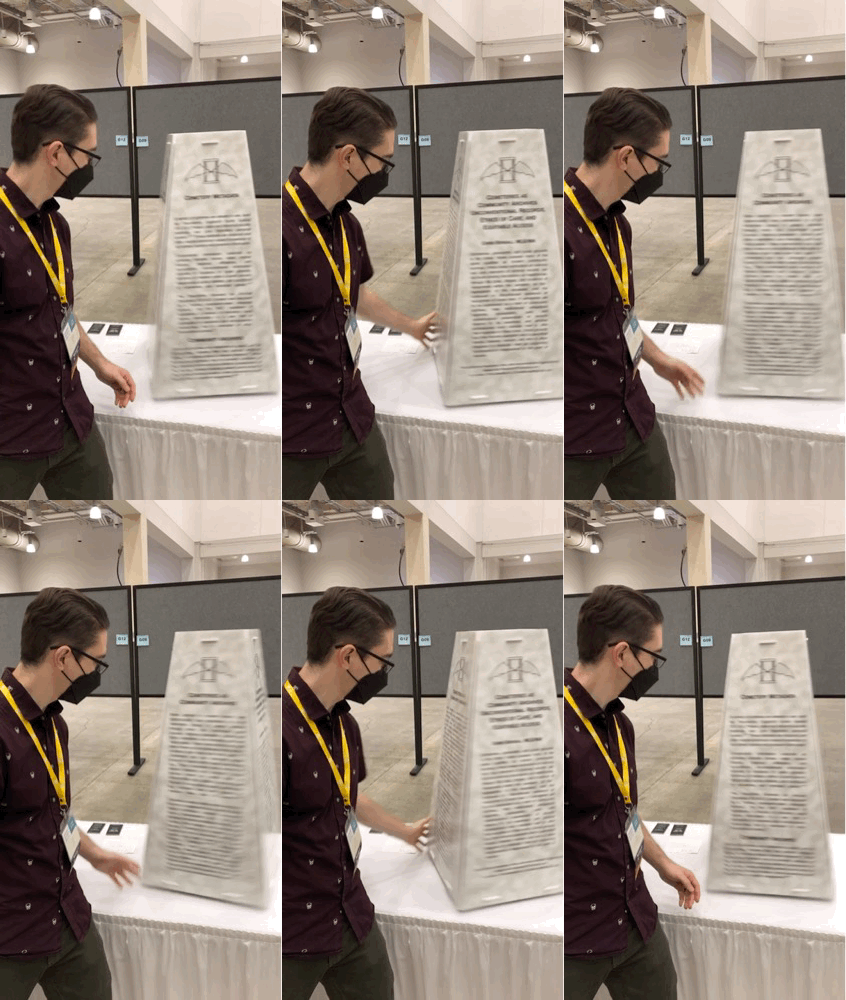
At the conference, posters and vendors were grouped into a spacious event hall. SAA planned for presenters to showcase their posters at three distinct times during the conference. I set up my poster Thursday morning, attended lectures throughout the day, and then gave my first soapbox that evening. I was, and still am, in awe at the positive response my presentation and ideas received. Additionally, numerous fellow archivists graciously offered suggestions for improvements, expansions, and further development. The two sessions on Friday proceeded in much the same manner. I am incredibly grateful to everyone who listened to me ramble and who offered their ideas.
Poster Content
I would like to preface this section by mentioning the digital poster is available for download via the button below—the physical poster contains the same information (though slightly reconfigured to fit all of the content).
As I mentioned above, I came to envision cemeteries as community archives based on the cumulative research from my capstone papers. Cemeteries, like other sites of cultural significance, can continually exist within a community (changing identity as the community changes) or be subject to processes of erasure—intentional or otherwise.
While a few large cemeteries are able to operate their own archives, these institutions are the exceptions rather than the rule. It is more likely that cemeteries in operation today store their documents in filing cabinets inside their offices or at non-climate controlled storage units.
Cemeteries also contain records beyond the conventional paper records retained by conventional archives. The burial markers themselves, more obviously, also contain information about individuals within the grounds. A little less obvious perhaps, is what I have come to consider second tier information, available upon closer observation of a burial marker. Examples of this second tier information include the marker’s material, size, location within a burial ground, proximity to relatives, physical condition, and several other elements.
When cemeteries are viewed as sites of community, and their documents and burial markers considered archival records, their erasure via damage, disrepair, or destruction inflicts harm upon the deceased, their attendants, and their histories. I further advocate for cemetery record preservation in the upcoming January/February 2023 issue of Archival Outlook (SAA’s “award-winning bimonthly magazine”). The entire magazine is open source, so be sure to check out their entire catalog.
Burial Marker Metadata
For my MLS capstone, I researched and created a metadata schema to record burial marker information. My goal was to create a system accessible to broad audiences, extensible to existing and future platforms, and one which centers the deceased and their communities as the subjects of the records. I hope to soon add an edited version of my Descriptive Elements for Archival Databases (D.E.A.D.) System to this website under its own tab.
Conference Summary
While it has taken me too long to finish this post, I still think back to my first SAA conference last summer and remember the wonderful connections met, the incisive wisdom shared, and the fantastic memories made. SAA’s leadership team made the poster presentation process easy and enjoyable and the conference a delight to attend. Should you have any questions about the conference or the process, please reach out and I would be happy to discuss! Additionally, any ideas regarding the D.E.A.D. System are more than welcome.
Semper disce (always learn)
-Chris
*All links captured by the Internet Archive
 Records of the Dead